


1

Budget 2017: key points at a glance

1

Growth

  • Forecast of 2% growth for 2017, up from 1.4%.
  • In 2018, growth forecast to be 1.6%, then 1.7% in 2019, 1.9% in 2020, and 2% in 2021.
  • Previous forecasts were 1.4% for 2017, 1.7% for 2018, 2.1% in 2019, 2.1% in 2020 and 2% for 2021.

Rowena Mason, deputy political editor: Philip Hammond looks satisfied to be announcing higher growth than previously forecast – a rare experience for chancellors in recent years. It defies the predictions of gloom by remain supporters before the Brexit vote, although the effects of leaving the EU are yet to be felt.

Borrowing

  • £51.7bn in 2016-17, £58.3bn in 2017-18, £40.8bn in 2018-19, £21.4bn in 2019-20 and then £20.6bn in 2020-21, and £16.8bn in 2021-22.
  • In November, borrowing was forecast at £59bn in 2017-18, £46.5bn in 2018-19, £22bn in 2019-20, £21bn in 2020-21 and £17.2bn in 2021-22.
  • Hopes of a surplus by the end of the decade already abandoned.

RM: Again, Hammond is able to deliver better news than previously forecast on borrowing. He stresses that this will not be used as a reason to spend more, signalling there will be no easing off on austerity. The chancellor moves on to a few digs at the opposition for ‘recklessly’ wanting to borrow more, carrying on George Osborne’s strategy of trying to paint Labour as fiscally irresponsible.

Small business tax

  • For businesses below VAT registration threshold, delay by a year the introduction of quarterly reporting at a cost of £280m.

RM: Hammond says this is a sign he is listening to the voice of business, unlike Labour, and shoehorns in a joke about the ‘last Labour government’ of Blair and Brown being called that for a reason.

Business rates

Three measures for England: a cap so rates rise by no more than £50 a month for small businesses losing their rate relief, pubs to get a £1,000 discount on business rates of less than £100,000 rateable value (90% of pubs) and a £300m fund for discretionary relief for local authorities. This amounts to a £435m cut.

RM: Inevitably, Hammond has had to take action to calm down the backlash against changes to business rates, given the outcry among Conservative MPs, small companies and the rightwing press. Cheers from the Tory benches suggest they will be satisfied by the concessions.

Tax avoidance

  • £820m of tax avoidance measures.
  • VAT on roaming telecoms outside the EU.
  • New financial penalty for professionals who create schemes defeated by HMRC.
  • Stop businesses converting capital losses into trading losses.

RM: Crackdowns on tax avoidance have become a budget staple to boost the exchequer’s coffers. This is another attempt to stop unfairness in the tax system, with added penalties on accountants who help people to try to dodge their liabilities.

Self-employment

  • Less tax paid by self-employed people will cost the taxpayer £5bn this year.
  • An investigation into tax treatment is being conducted by Matthew Taylor of RSA.
  • Treasury to raise £145m from increasing national insurance contributions of some self-employed people.

RM: Hammond has had to go into a very lengthy explanation justifying this on the grounds of improving fairness in tax levels between the employed and self-employed. This has the potential to be controversial with some traditional Conservative supporters, who are likely to see it as an assault on entrepreneurialism and an unwanted rise in a personal tax.

Tax-free dividend allowance

Cut from £5,000 to £2,000 from April 2018.

RM: This is another change that may annoy traditional Conservatives, but will please those who have long thought it unfair that shareholders can gain tax advantages by taking earnings through dividends rather than a salary.

Duties

  • Sugar tax set at 18p and 24p per litre for the main and higher bands (more than 5g of sugar per 100ml and more than 8g per 100ml respectively).
  • Freezing vehicle excise duty for hauliers and HGVs.
  • New minimum excise duty on cigarettes.
  • No changes to duties on alcohol and tobacco.

RM: The traditional ‘sin taxes’ on booze and cigarettes are not rising, but a new one is being introduced in the form of the sugar tax. It is one of the few flagship policies of David Cameron continued by May.

‘National living wage’

Rises to £7.50 an hour in April.

RM: This is merely confirmation of what Hammond said in last November’s autumn statement. It is a rise, but not enough to meet the target of £9 an hour by 2020 on its current trajectory.

Personal tax allowances

As expected, £11,500 for basic rate taxpayers.

RM: This is a continuation of the Conservative-Liberal Democrat coalition government’s trend of raising the personal allowance to reduce income tax paid for all but the very highest earners. Originally it was taking the very lowest paid out of tax altogether, but critics argue that a better way to do that now would be to raise the national insurance threshold instead, bringing it in line with the income tax threshold.

Savers

The promised NS&I three-year bond paying 2.2% will be available from April on savings up to £3,000.

RM: This is simply confirmation of an autumn statement measure, which appears to be a bit of filler in the speech rather than a new announcement.

Women

  • £20m fund to combat violence against girls.
  • £5m for ‘returnships’ – helping people back into work after a career break.
  • £5m for projects to celebrate the 1918 Representation of the People Act.

RM: Hammond’s announcement prompted a lighthearted dig at May for already announcing two out of the three measures on Mumsnet on Tuesday night. She managed a bit of banter in return, retorting: “It is International Women’s Day.”

Consumers

Green paper on protecting consumers to be published.

RM: This is as expected, with few details in the speech, with the government once again channelling Ed Miliband, who hit out at ‘rip-off Britain’ in the previous parliament.

Training

  • £300m for 1,000 new PhD placements.
  • £270m for disruptive technologies such as robotics and driverless vehicles (the ‘industrial strategy challenge fund’).
  • A £16m 5G tech hub.

RM: A big theme of the Treasury under Hammond has been improving training opportunities in science and technology. The sums involved are not huge, but Hammond has repeatedly signalled there will be few big giveaways in this budget.

Education

  • White paper to be published.
  • Funding of £320m for 110 new free schools to take the total to 500.
  • Free school transport extended to children receiving free school meals at selective schools.
  • £216m invested in school maintenance.

RM: This measure was widely trailed in Tuesday’s papers, with a focus on May’s decision to allow the new free schools to be selective grammar schools. It will be fiercely opposed by Labour and the other opposition parties.

Careers

  • Introduction of T-levels – technical qualifications, an alternative to A-levels – for 16- to 19-year-olds.
  • £40m for pilots on lifelong learning projects.

RM: This was also widely trailed by the Treasury as part of its focus on increasing the status of technical education.

Local government

  • Midlands engine strategy to be published.
  • £690m competition for local authorities to tackle urban congestion.

RM: This is a development of George Osborne’s ‘northern powerhouse’ strategy attempting to spread prosperity beyond the south-east. May has slightly shifted the focus to make sure all regions are targeted with an active industrial policy and the Midlands engine appears to be the latest plank of this plan.

Scotland, Wales and Northern Ireland

  • £350m for the Scottish government.
  • £200m for the Welsh government.
  • £120m for the Northern Ireland executive.

RM: May has placed a huge emphasis on keeping the union together. The sums involved are sizeable, but hardly a gamechanger to quell the clamour for a second independence referendum among SNP supporters.

Social care

  • £2bn over the next three years for England.
  • Green paper on social care funding to be published later this year.

RM: This is a fairly dramatic climbdown for Hammond, who was severely criticised after the autumn statement for barely mentioning the NHS or social care crisis. In the ensuing debate, he repeatedly insisted there was no need for a bailout of the social care system. But the pressure from Tory councils, NHS chiefs and backbenchers has obviously proved too great.

NHS

  • £325m of capital for the first of the new sustainability and transformation plans (STPs), intended to improve healthcare.
  • £100m for 100 onsite GP treatment centres in A&Es in England.
  • Hammond promises announcement of multi-year capital programme later in the year.

RM: The £100m injection into the NHS is a small amount compared with what medical chiefs say is needed. However, allocating money for a specific reform fits with No 10’s strategy of asking the health service to work more efficiently.


1   2 March 2017

By Will Dunn

1

The architect of the “Northern powerhouse” on why we should start thinking about the TransPennine Express like the London Underground.

One of the chairs in George Osborne’s office has money on it. Not a lot of money – it looks to be about £2.30 – but the sight of it stops us before we sit down. “Must have fallen out of someone’s pocket,” says Osborne before, ever the taxman, he scoops up the coins and transfers them to a nearby table. It is very difficult to watch the man who was until June in charge of the world’s fourth-largest economy fiddling with two quid in coins without observing that the former Chancellor has been forced, just lately, to deal with a spectacular amount of change.

“When I left Downing Street in July,” he says, “I had a choice about what I wanted to do with my political energy. Of all the initiatives that I did in government, I don’t think anything has caught on and developed a life of its own as much as the Northern Powerhouse.”

Osborne is a northern MP, of course, albeit for a constituency in which former members of the Bullingdon Club are likely to feel at home. A Barclays survey in 2003 found that Tatton was the wealthiest area in England in terms of disposable income. The constituency’s largest town, Wilmslow, has the UK’s busiest Aston Martin dealership and more millionaires per capita than anywhere in the UK outside of Mayfair. Alderley Edge has an average house price of £589,000. On the other side of the Peak District is Barnsley, where the average house price is £126,000.

“It’s a very comfortable part of the world,” Osborne concedes, “because people are in work, and the area is on the up, and there is a beautiful natural environment around it. It’s an interesting community, because there’s also a constant pressure on things like housing, making sure people can afford to live in the area they grew up in. There are serious pockets of deprivation in the constituency. In many ways, I think it’s very representative of Middle Britain.”

But does Tatton represent the North? “The North is not one homogenous community. You can go from the wildest, remotest countryside, the Yorkshire Dales and the North Yorkshire Moors, to deprived inner-city communities in Liverpool, to some of the most successful manufacturing centres and financial centres in Britain, whether it’s hedge funds in Leeds or aerospace factories in Lancashire. The North is not different from any other part of the country, except that it does have a shared feeling that it is the north of England, a shared geographic identity, and a shared connection to an industrial past. And I think, a shared sense that sometimes it has been neglected, and London dominates – that feeling, by the way, you would get in other parts of Britain as well, but it’s one of the things I’m trying to address.”

Are there not more important divisions in British society than north and south? The gap between rich and poor increased dramatically under both Labour and Conservative governments, with incomes rising by 64 per cent for the top fifth of earners while the bottom fifth lost 57 per cent. The intergenerational gap, too, is becoming a chasm; now, for the first time in British history, a pension pays more than a job.

Osborne says it is “a trap… to say that there are no really serious geographic differences in Britain, [that] it’s all between deprived communities and better-off communities. I think then, you miss a broader point, which is, in the modern global economy, very big cities are becoming absolutely dominant. That’s not necessarily what you would have expected. You might have thought that the internet and the ability to work from home, cities would become less important. That’s not the evidence – all around the world, growth is clustering around big cities. People want to be together, spark off each other, create innovation together. And Britain only has one global city – London. It is probably the most successful of all the global cities, and I think it’s of enormous benefit to the whole country that, located on these islands is this great global city, but it does create quite an imbalance in the economy, which obviously has been growing over the decades.”

 1

UK house prices continue to move upwards – Nationwide

Updated / Wednesday, 1 Mar 2017 08:24

1

UK house price growth accelerated in February, with the average property value standing 4.5% higher than a year ago.

A 0.6% month-on-month price increase in February took the average UK property value to £205,846, new figures from the Nationwide Building Society show.

In January, UK annual house price growth had stood at 4.3% and house prices had increased by 0.2% month-on-month.

Robert Gardner, Nationwide’s chief economist, said a small rise in house prices of around 2% is more likely than a decline over the course of 2017, as low mortgage rates and a dearth of homes on the market continues to support prices.

“Recent data suggests that the UK economy has continued to perform relatively strongly,” he stated.

“The outlook is uncertain, but we, along with most other forecasters, expect the UK economy to slow through 2017 as heightened uncertainty weighs on business investment and hiring,” the economist said.

“Consumer spending, a key engine of growth in recent quarters, is also likely to be impacted by rising inflation in the months ahead as a result of the weaker pound,” he added.

Mr Gardner also said cash buyers are a more important driver of the housing market than they were a decade ago.

He said the share of cash transactions has increased significantly, from around 20% in 2005-2006 to around 35% in 2008, remaining fairly constant since then.

“The sharp increase in the share of cash purchases in 2007 and 2008 was a function of mortgage transactions declining sharply, rather than the amount of cash transactions increasing,” he explained.

“This reflects the impact of adverse labour market conditions and the tightening of credit conditions during the financial crisis, which limited the number of people able to buy with a mortgage, while fewer such constraints would have applied to cash purchasers,” he added.

UK cash sales rose to a peak of 38.9% of transactions in the first quarter of 2016, as buy-to-let investors rushed to beat a stamp duty hike imposed last April.

The ageing population in the UK is also prompting more cash sales, with people who are downsizing for example being more likely to buy their new home in cash, having paid off their mortgage years ago.

In London, the share of cash purchases tends to be lower than the UK generally, with house prices in the capital being more than double the UK average.

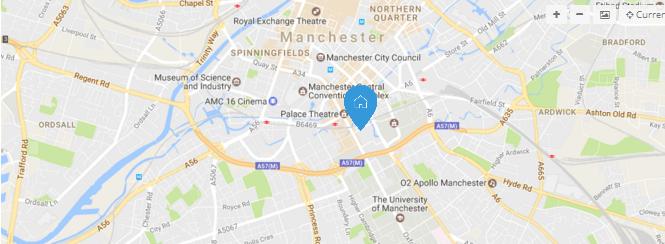
WE RESIDENCE – M1 Charles Street, Manchester M1, 7BD

  • WE RESIDENCE perfectly locates in Manchester City Centre
  • Only 3 mins walk to the University of Manchester and 2 mins walk to Oxford Road Station. 8 storeys residential building,11 Studio, Designed by award-winning architects
  • Net rental yield approximately 5%-6%
  • We-Residence-M1 Management Limited will provide full tenancy and rental services

bracken-wider map

Excellent Location:

  • 3 minutes walk to University of Manchester & Manchester Metropolitan University
  • 9 minutes walk to the central library
  • 17 minutes walk to the commercial district Spinningfield
  • 17 mins transit Old Trafford soccer stadium

5 WE-photo2 WE-photo4

Highlighted Investment: Last 3 Apartments, NET rental yield of 5& – 6%

1

Facilities

  • 24 Hour Security
  • Landry Room
  • Ensuited bedroom

Why Investment in Manchester?

  • Manchester is ranked as the best buy-to-let hotspot with an average rental yield of 6-7%, compared to just 2- 3 % in London
  • Occupancy rate are currently at 96%, reflects the high demand of rental apartments
  • Student Accommodation are seriously undersupplied
  • More than 2,000 overseas business based in Manchester providing a wild variety of international investments
  • High demand for city centre property from well-paid city workers

Contact us

1   By Andrea Wong, 21 February 2017

Top locations for property investors in 2017

Whilst the capital remains a popular choice for investors, many landlords have looked beyond London and to the North in anticipation. With rapid renovations to the Greater Manchester area and plans to develop the Liverpool city centre further, it is a great time to start looking further afield, especially with property prices soaring in London without an increase in the cost of rent. The gap between the average cost of property in London compared to the rest of the UK and Wales is becoming wider.

1

According to figures published by JLL, London underperformed in terms of rental yields compared to the rest of the country. With Brexit looming and causing uncertainty within the country, it has affected the capital the most. As a result of this, location is becoming an even more challenging aspect for landlords when looking to invest in property. With that in mind, we recommend that they look to invest in other cities. There are diverse and up-and-coming cities in the North that offer a range of impressive boutique student accommodation and residential properties.

Greater Manchester

Greater Manchester is expected to remain one of the UK’s most popular property investment destinations, with the balance between earning potential and property prices much more favourable than in the capital. One of the areas that has seen a remarkable transition in recent years is Salford’s MediaCityUK, which has become a creative hub for large corporations with both ITV and BBC relocating to the area from the South. According to JLL reports, Greater Manchester is outperforming the rest of the UK in terms of its GDP growth which is continuing to rise and is predicted to increase by approximately 5% annually until 2020.

Liverpool

A city at the heart of the government’s Northern Powerhouse initiative is Liverpool, with Chinese buyers particularly keen to invest in the area. Described as ‘one of the most pleasant cities in northern England’, Liverpool is home to some of Britain’s most ambitious developments and infrastructure schemes that have been valued at over £7 billion. Foreign investors have been tempted to invest in the city due to the weak pound after the EU referendum vote, high yields and a high demand in occupancy. With a total of four universities located in the area, and the University of Liverpool alone attracting many foreign students due to its partner university in China, there is a huge student population ensuring that there will always be potential tenants, especially with properties close to universities.

In addition, figures from Hometrack show that house prices in the city have grown by 2.6% in the past quarter, and with more development plans in the city this is the ideal time for landlords to take advantage of enormous investment potential.

Leeds

With a reputation as a cosmopolitan area, Leeds is truly an exciting place for both students and professionals to live in. The vibrant city boasts of the largest and fastest-growing workforce in the UK, making it a location where people tend to settle, so it is no surprise that investors are finding it the ideal city to invest in. The cost of living is over 20% lower than in the capital and with unwavering employment opportunities, the future is bright and would be a secure location to invest in.

Figures from Rightmove which show a 4% increase in house prices over the past year, and an increase of 10% since 2014, only underline the strength of the city’s housing market.


1

NAEA Propertymark (the National Association of Estate Agents) has today released its January Housing Report, which shows that an average of 11 buyers are now chasing every property on the market.

1

An imbalance between supply and demand means that every homebuyer is facing competition from ten more prospective buyers.

Housing demand

The average number of prospective buyers registered per estate agency branch in January was 425 – up by 10% on December 2016, when NAEA members registered 386 on average.

Property supply

The amount of properties available to buy on estate agents’ books in January stood at an average of 38. This is down from 41 in December, and the lowest recorded since July 2016.

The rise in homebuyers and decrease in properties on the market means there is an average of 11 buyers chasing every home.

Home sales 

In January, three in ten (30%) property sales were made to first time buyers – a slight decline from December, when 32% of sales were made to this group.

The number of sales agreed per branch rose from an average of six in December to eight last month – returning to the same level seen in November.

Sale prices

More than one in every 20 properties (7%) sold for more than the original asking price in January – the highest amount since April 2016, when 9% sold for more than the asking price.

The Chief Executive of NAEA Propertymark, Mark Hayward, says: “January saw a surge in buyers looking to kick off the New Year with a new home, but competition is rife, with an average of 11 buyers chasing each property.

“The increase in the number of properties selling for more than the asking price in January could be a result of heightened interest and the fact there is simply not enough housing to meet demand.”

He adds: “When the Government issued their Housing White Paper at the start of February, we stated how important it was for the industry to put forward robust solutions to really make a difference, and it’s vital that building more affordable housing is at the very top of their agenda.”

1

Chinese apartment buyers shift from Australia to UK

Regulators crack down on foreign lending amid fears of property price bubble

1

February 26, 2017

by: Jamie Smyth in Sydney and Yuan Yang in Beijing

Zhang Biao, a 32-year-old Chinese entrepreneur, has already thought about where his eight-year old will go to university. “We thought a flat overseas would be a good investment, and our son could use it for sixth form or university in Australia or the UK,” he says.

Mr Zhang and his wife put an offer down on a A$600,000 (US$460,000) flat in Melbourne in October, only to be told that they were no longer eligible for the 60 per cent loan-to-value mortgage they had applied for. Instead they decided to pay up front for a £120,000 flat in the English city of Liverpool. Mr Zhang is one of a growing number of Chinese property investors switching their focus from Australia to other markets as regulators — eager to moderate rapidly rising prices amid fears of a bubble — have increased pressure on banks to curb foreign lending.
This month, the Reserve Bank of Australia warned that residential building activity had been 50 per cent higher than long-term averages for two years and there was a risk that “newly completed apartments fail to settle”. A sharp correction in the property market could tip Australia into its first recession in a quarter of century, analysts warn. Gross domestic product contracted in the third quarter by 0.6 per cent, although most economists expect economic growth should resume in the fourth quarter. “We believe the [property market] correction will start with settlement problems for low quality apartments,” said broker CLSA in a recent report. “Our worst-case scenario would result in dwelling prices falling in all areas, eventually leading to a recession.”

1

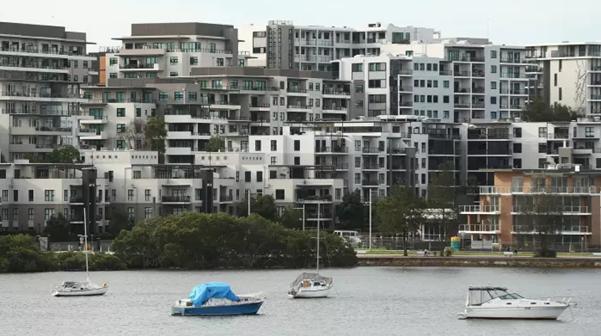
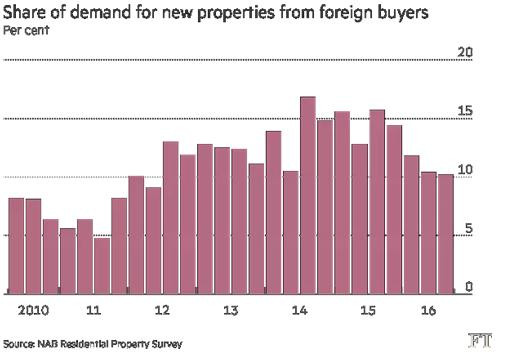
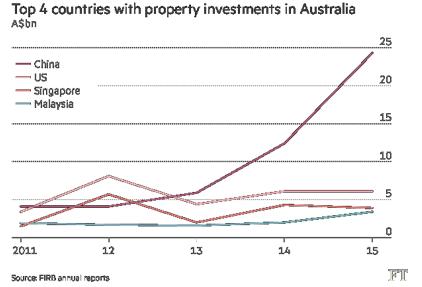
The boom in foreign property investment has helped the Australian economy to continue growing despite sharp falls in mining investment. In 2014-15 Chinese investors were granted approval to spend A$24.3bn on property, more than three times the value of purchases from the US, the second largest group of foreign investors. The inflow of foreign capital helped push prices up in Sydney and Melbourne, the two biggest cities, by 67 per cent and 47 per cent respectively, over the past four and a half years. Foreign buyers account for one in five apartment sales. Now overseas demand is starting to weaken. Over the past two years the proportion of new property sales accounted for by foreign buyers in Australia has fallen from 16.8 per cent to 10.9 per cent. This drop is particularly felt in the apartment market. Building approvals for apartments fell by a fifth in the year to end-December. Unit prices have begun to moderate in Melbourne and Brisbane, edging up by only 1.7 per cent and 2.3 per cent respectively last year. “Chinese buyers are increasingly nervous about Australia because of recent instability in regulation, tax and bank lending rules,” says Esther Yong, co-founder of ACproperty, a Chinese language property portal. “A lot of Chinese who bought apartments off-plan three years ago are now finding it difficult to find finance as Australian banks have blocked lending to foreign buyers.”

1

The big four Australian banks — NAB, Commonwealth Bank of Australia, ANZ and Westpac — have all stopped issuing loans to non-resident borrowers with no domestic income. “We have essentially shut down mortgages to non-resident buyers,” Shayne Elliott, ANZ’s chief executive, told the Financial Times. He said the apartment market in Melbourne was “a little bit concerning” due to the proliferation in the city centre of small apartments, some under 50 square metres in size and with no bedroom windows. The withdrawal of bank financing has forced some property developers to ramp up vendor financing, which can leave buyers exposed if prices then fall. Meriton, Australia’s biggest apartment builder, offers buyers two-year loans, providing them with some breathing space to find alternative financing. “Our loan book has doubled over the last 12 months to about A$120m as the rule changes have left some foreign buyers in limbo,” said James Sialepis, sales director at Meriton, Australia’s biggest apartment builder. Other developers have begun offering discounts and rental guarantees on some properties. Increasingly, Chinese buyers are looking elsewhere. ACproperty recently teamed up with property listing company Listglobally, to launch a Mandarin language housing site called Sodichan.com focused on other international markets. “Our agents in China have been asking us to supply them with properties in other countries,” said Ms Yong. She said the UK had become popular after the Brexit vote because the fall in the value of sterling had made it cheaper for Chinese buyers. But Beijing’s tough new capital controls are making it more difficult to move large amounts of cash out of China. Foreign property investments by Chinese companies plunged by 84 per cent last month, according to the Chinese Ministry for Commerce. “For some Chinese buyers who have family connections in Australia, they will continue to buy there. But for others without these specific reasons, they will look at other opportunities,” said Ms Yong.

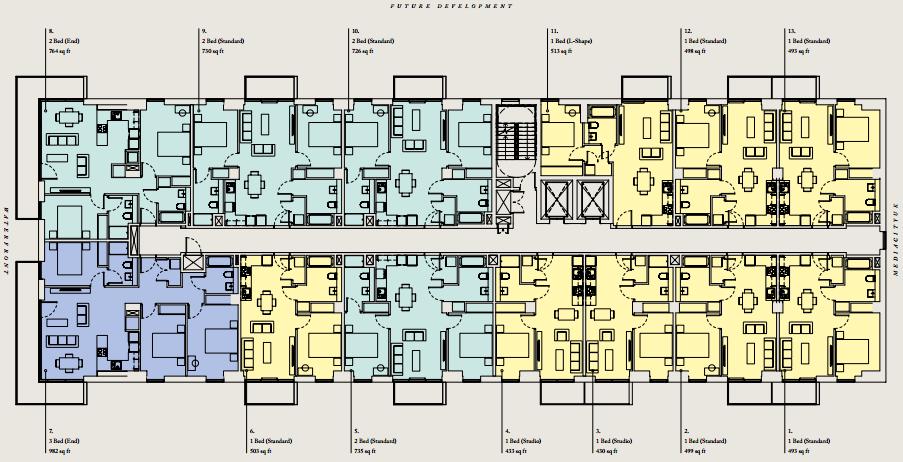
Lightbox  is an exciting new scheme featuring 238 apartments

  • 1,2 & 3 bedroom available, ranging from 430 sqft for a one bed studio to 984 sqft for a three bed apartment
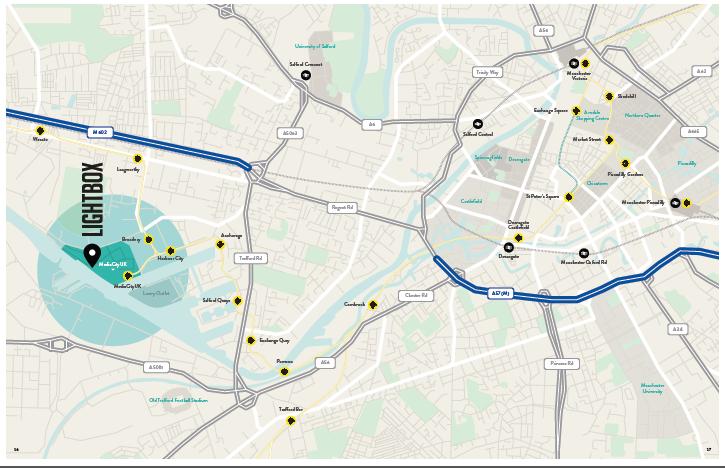
  • It is a brand new off plan development that sits on the waterfront at MediaCityUK. A location with landscape gardens on the water side . Home of the BBC ,ITV Coronation Street and other Media Companies
  • The 19 storey building will boast breath-taking views over MediaCityUK, the waterfront, Coronation Street and Manchester’s skyline.
  • Estimated Completion: Q1, 2019  

    Price Starting from £235,500 – £385,500 (Parking available with extra cost)

lightbox-salford-quays-cgi-resized MediaCityUK-lightbox_1

Nearest Station

MediaCity UK (0.1ml)

Broadway (0.3ml)

Harbour City (0.4ml)

Nearest Shopping Mall

Trafford Centre and the Arndale Centre

Lowry Outlet at MediaCityUK

map MAP1

Education

  • Over 105,000 students across four universities; Manchester University, Manchester Metropolitan University, the University of Salford and the University of Bolton
  • The nearest university is University of Salford
  • The university population is one of the largest in Europe
  • Manchester has a well educated, skilled workforce of 1.3 million
  • and a GDP of £28 billion

The apartments at MediaCityUK offer a fantastic investment opportunity, being situated in Europe’s largest and    newest media hub 

BBC North & ITV:  The area is brimming with leading digital and media companies.

UK Northern Powerhouse:  Stimulate economic growth, £5 billion has invested for regeneration

Economic:  Generating over £56 billion of GVA, Manchester City contributes 52% of the Northwest’s total economic output

floorplan

Contact us

1

Manchester property set for 28.2% price growth

The Manchester property market is expected to see capital value growth of 28.2% over the next five years, as a result of growing demand and low housing supply.

Summary

  • North-west property price growth is outpacing the rest of the UK
  • Manchester is predicted to see price growth of 28.2% by 2021
  • Property advisor JLL expects Manchester to be among the first choice for international investors targeting the UK’s build-to-rent sector


North-west house prices will increase by 18.1 % over the next five years, according to research carried out by property advisor JLL. This data follows a strong year for Manchester’s residential sector in 2016 which saw a 16% growth in capital values.

Buoyed by high demand and low supply, growth in the region is currently outpacing the rest of the UK. JLL predicts that as a result of this undersupply, rents and capital values will continue to increase dramatically in the coming years.

Capital value in Manchester is expected to see growth of 28.2% in the next five years, while rents are forecast to increase as much as 20.5% by 2021.

While the EU referendum vote has seen a marginal slowdown in transaction levels and a mild easing in prices, research experts at JLL are optimistic that Brexit will not negatively impact the growth of north-west property prices.

Adam Challis, Head of UK Residential Research at JLL, said: “In markets where there’s still a significant undersupply we’re set to see growth over the next five years, and the north-west in particular is a prime example of this.”

Stephen Hogg, Head of North West Residential at JLL, said: “Our five-year forecast points to the continued strength of the residential sector in the Northern Powerhouse. Manchester now offers some of the best returns in the UK and is at the forefront of the build-to-rent market in the UK regions.”

According to JLL, Manchester requires 3,300 new homes each year in order to meet current demand and expects build-to-rent developments will soon be at the centre of new schemes in Manchester. With a large number of developments in the pipeline and a significant price growth forecast, the city is expected to be among the first choice for international investors targeting the UK’s build-to-rent sector.

Property Investor Today

15 February 2017

By Marc Da Silva

Housing shortage and cheap borrowing will continue to support UK house prices

UK house prices may have ended last year around £15,000 higher on average than when the year started, but the signs are that prices will continue to rise, supported by a ‘critical shortage’ in housing supply and ‘ultra-cheap borrowing rates’.

House prices across the UK as a whole increased by 7.2% in the year to December, accelerating from a 6.1% rise recorded in the year to November, pushing the average price of home up to £220,000, according to the Office for National Statistics (ONS).

The average price of a residential property is now £236,000 in England, £148,000 in Wales and £142,000 in Scotland, according to the ONS.

The East of England was the region with the highest annual growth, according to the ONS, with prices increasing 11.3% in the year to December 2016. Growth in the South East of England was 8.5% for the year. London, which continued to be the region with the highest average house price, at £484,000, was the third fastest-growing region with prices rising by 7.5% in the year to December.

Property prices in all three regions have been pushed higher mainly by a widening supply-demand imbalance in the market, coupled with record-low mortgage borrowing rates, and this trend looks set to continue, not just in the London, the East and South East of England, but across the UK as a whole, according to Rob Weaver, director of investments at property crowdfunding platform Property Partner.

He said: “At the risk of sounding like a broken record, the critical shortage in supply, alongside ultra-cheap borrowing rates are supporting house prices and that looks set to continue.

“Until more properties are built for both buying and renting, the market for investors looks positive as prices continue to move upwards although overall at a gentler pace than before.”

Tax changes, stricter lending criteria and regulation appear to have been somewhat dampening buy-to-let demand, but Weaver points out that owner occupiers remain the “driving force behind prices”, particularly in the regions.

He added: “The housing market may have plateaued during last summer but for the final two months of 2016, prices regained momentum.

“With December, in particular, seeing a higher than expected rise in annual prices, property demonstrated itself to be a robust investment once again in 2016.”